
The kennel journal
Miniature Husky: Everything You Ever Wanted to Know
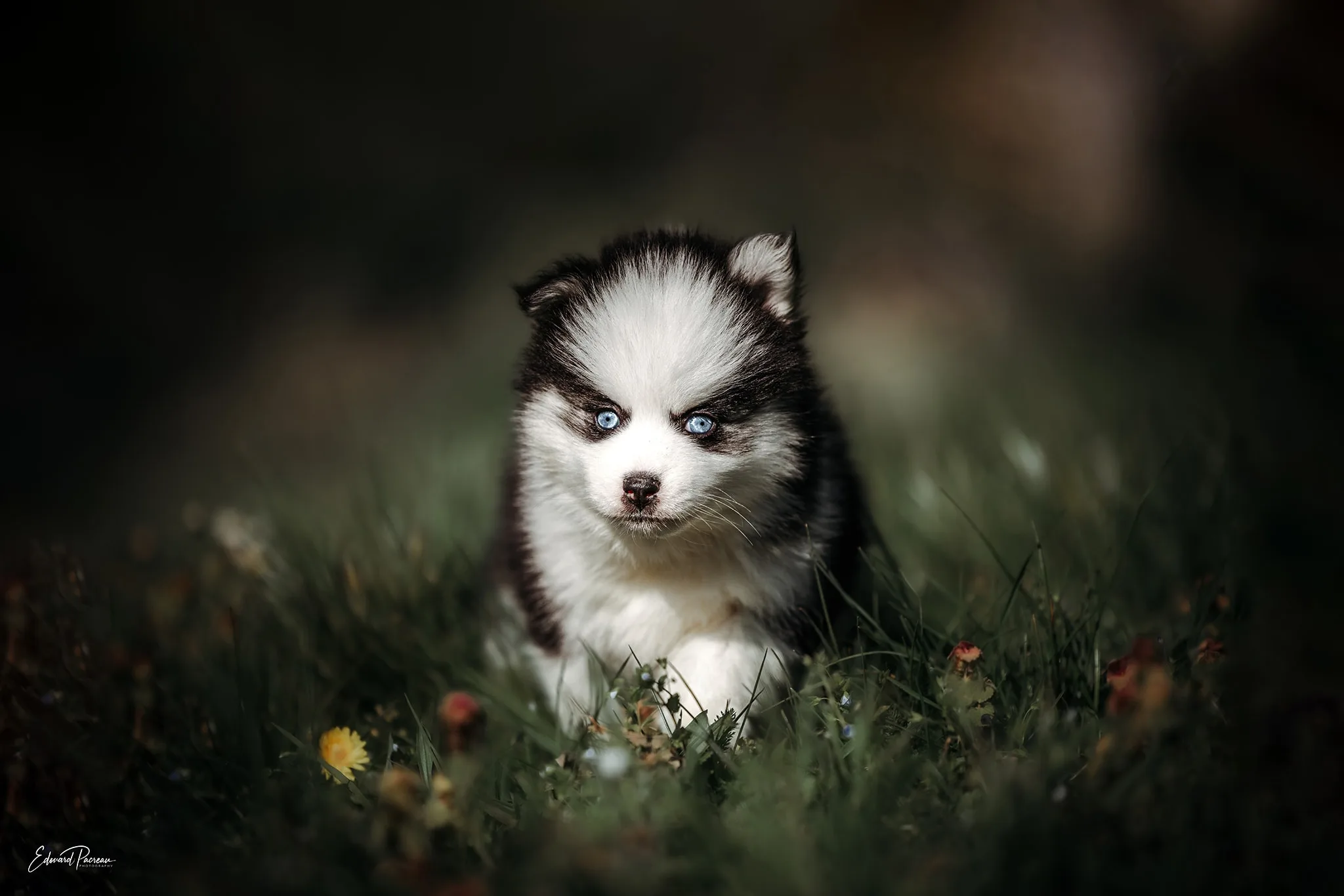
The Husky is a dog many of us dream of. It is a dog of great elegance, with a unique appearance, and it is highly intelligent. But it is also a dog that demands a great deal of physical activity, company and flawless training. So the Husky remains a dog that many French people dream of, while knowing they have neither the environment nor the time needed to give it a good home.
In this article, then, we are going to look at whether there are alternatives to the Husky: a smaller dog, needing less physical activity, that would keep the Husky’s appearance.
There are indeed various breeds and crosses resembling a miniature Husky. Among them we can mention the Alaskan Klee Kai, the Pomsky and the Pomklee. On top of that, some Russian breeders are said to have succeeded in reducing the Husky’s size and to have created genuine miniature Huskies.
A miniature Husky: the Alaskan Klee Kai
This is a dog from North America, and more precisely from Alaska. It is a small dog that strongly resembles a miniature Husky, both in build and in character traits.
Physically, this miniature Husky measures between 33 and 44 cm at the withers and generally weighs between 4 and 10 kg. Because of its size, the Alaskan therefore adapts to apartment life and to a city environment. Physically, the Husky and the Alaskan Klee Kai closely resemble one another: almond eyes, straight triangular ears, short coat, pointed muzzle. And the Alaskan Klee Kai also has the famous blaze-shaped mask that made the Husky’s reputation.
So it is a small dog with a lean, elegant look, and its coat colours are similar to the Husky’s: grey and white, black and white, chocolate and white.
Like the Husky, the Alaskan Klee Kai is an active dog that needs to burn off energy. It is lively, intelligent, curious and stubborn. It adapts well to family life with children, as long as its needs are respected.
Like many primitive and northern dogs, this mini Husky can be independent and prone to escaping. So it is important to have a well-fenced plot. What is more, it is also a dog with a strong prey drive. An excellent hunter, so if you have other pets you will need to work on their introduction from a very young age. Finally, the Alaskan Klee Kai is by nature rather wary and fearful with strangers.
The Alaskan Klee Kai is a recognised breed, but it remains rare in France. Prices for a puppy range from 2,500 to 4,500 euros depending on sex, size and eye colour.
The Pomsky: a miniature Husky
Unlike the Alaskan Klee Kai, the Pomsky comes from a cross between two existing breeds, the Siberian Husky and the Pomeranian. The Pomsky is therefore a cross between two primitive breeds. The aim of that cross is to reduce the Husky’s size but also to soften its character. It becomes an affectionate dog, entirely suited to city life. The first Pomskies were created in the United States in the 2000s, and today they are found in many countries: the United States, Russia, England, France, Belgium, Switzerland. More and more breeders are starting to work with this cross. It nevertheless remains hard to find for the moment in France and, more broadly, in Europe.
The appearance of this miniature Husky
Physically, there is great variety among Pomskies. The primary aim was to obtain a dog closely resembling the Husky, with a blaze mask, pointed ears and an elongated muzzle, all with the Pomeranian’s touch of a soft, woolly coat and a curled tail.
It is that big-teddy-bear look that made the Pomsky famous. Videos of this dog quickly went viral before doing the rounds of social media.
The Pomsky’s character
The second aim of this mix was also to soften the Husky’s character. Although many families are very happy and build a wonderful bond with their Husky, it remains a primitive working dog that needs a great deal of exercise. The Pomeranian’s contribution breaks up that primitive character, and the Pomsky is better suited to family life.
The Pomsky does indeed have a character that families like a great deal. It is a devoted dog, very affectionate, that loves being glued to its owner. It is generally not a barker, and the Pomsky gets on perfectly with children and other animals. It is a playful little dog that will make you smile. On the other hand, it is a dog that does not like being alone and that has a strong will of its own. Cunning, it also knows how to bend the rules and to make itself understood when it disagrees. The Pomsky can be prone to escaping if the garden is not well fenced. It is also a sensitive little dog that copes badly with solitude. To learn more about the Pomsky’s build, size and character, here is another of my articles: Everything you need to know about the Pomsky
Pomsky generations
The Pomsky remains a very new cross that came into being less than 20 years ago. So it is important to take the time to find out about Pomsky generations in order to choose your future companion well.
There are indeed different generations of Pomsky.
From generation F1 to F5
- The F1 Pomsky: called the first-generation Pomsky, it comes from a cross between a Husky and a Pomeranian. In terms of DNA it will be 50/50, so it will have as much Husky blood as Pomeranian.
- The F2 Pomsky: called the second-generation Pomsky. It comes from a cross between two F1 Pomskies and, in terms of DNA, will be 50% Pomeranian and 50% Husky.
- The F3 Pomsky: called the third-generation Pomsky. It comes from a cross between two F2 Pomskies and will likewise be 50% Husky and 50% Pomeranian.
The aim of progressing through the generations is to arrive at physical and behavioural stability.
The A and B generations
You will also see F1b and F2b Pomskies. These Pomskies come from pairings between a Husky and a Pomeranian. In terms of DNA, your Pomsky will therefore be 75% Husky and 25% Pomeranian. It will have an appearance and a character closer to the Husky: independent, stubborn, active, energetic. So it is important to know whether you will have the skills and the time to manage an Fb Pomsky.
F1a and F2a Pomskies, meanwhile, come from a pairing between a Pomeranian and a Pomsky. They will therefore have 75% Pomeranian blood and 25% Husky blood. Their build and character will consequently be much closer to the Pomeranian. Here too, it is important to know whether that is what you are looking for.
The Pomsky’s size
The Pomsky is a mini Husky, so it is a small to medium-sized dog. Depending on the generation and the line you choose, your Pomsky may range from 5 to 20 kg. So it is important to do your research and to talk to your breeder in order to be steered towards the right size.
It is difficult to predict a Pomsky’s size, because within a single litter puppy weights can differ twofold. That said, a breeder who knows their lines well will be able to guide and advise you.
Despite much that has been said, an F3 or F4 Pomsky will not necessarily be smaller than an F2 Pomsky. It all depends on the breeder’s selection. So it is worth finding out about the parents’ weight rather than about their generation.
The price of a miniature Husky
Pomsky prices vary a great deal and depend on various criteria:
- The generation
- The build
- Eye colour
- The country of purchase
On average in France, the price of a Pomsky ranges from 3,000 to 6,500 euros. That budget is explained by the purchase price of the breeding stock, the health tests, the difficulty of breeding, and also by supply and demand.
As you will have gathered from this article, it is now possible to have a miniature Husky in an apartment and with a city lifestyle.