
The kennel journal
Pomsky FAQ
1. What is a Pomsky?
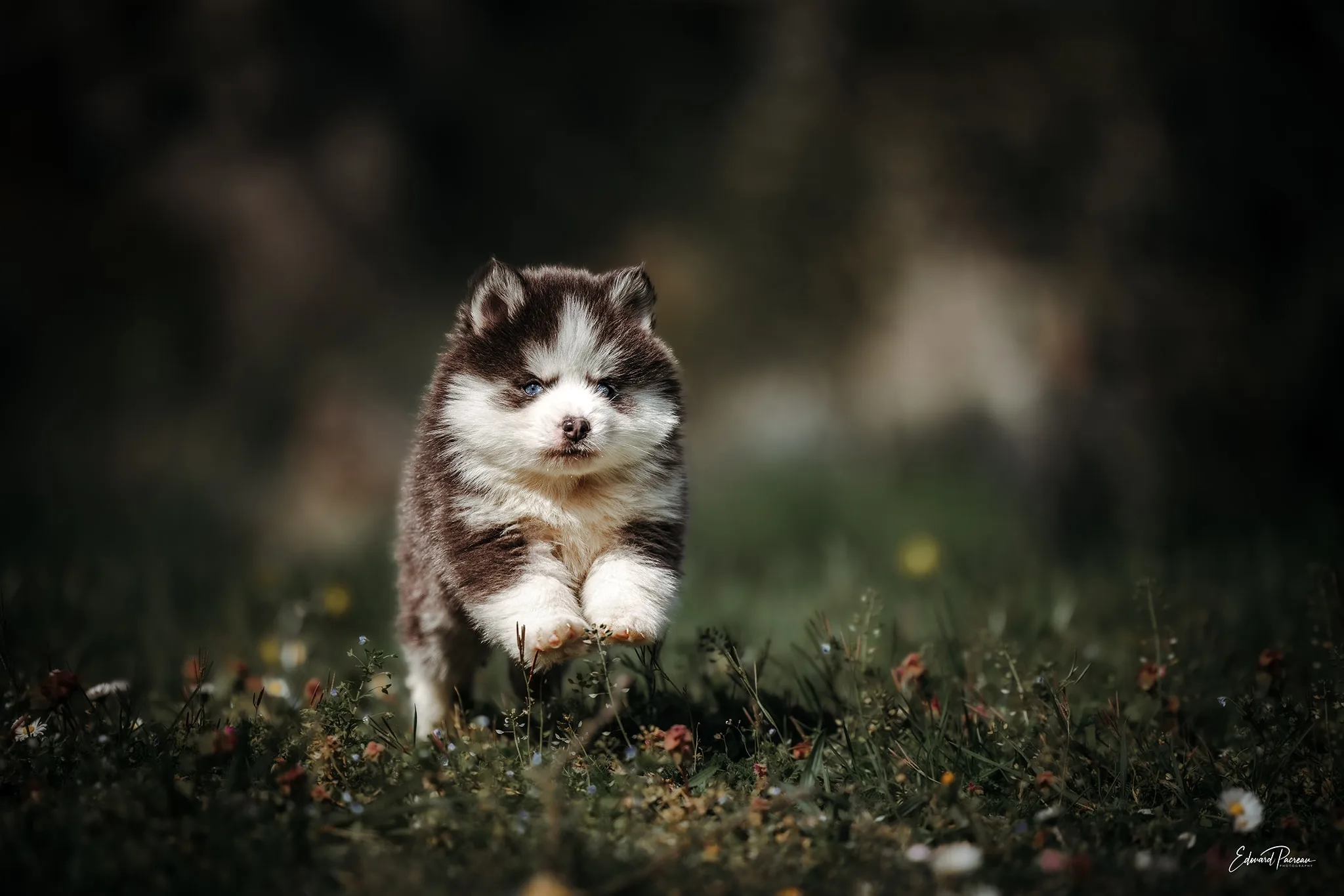
The Pomsky is a relatively recent hybrid, resulting from the cross between a Siberian Husky and a Pomeranian. These dogs have grown in popularity thanks to their adorable appearance and their lively personality.
The Pomsky combines the Husky’s majestic charm with the Pomeranian’s small size and mischievous character. It is a perfect companion dog for anyone looking for a small to medium-sized dog with a slightly wild look. Because of its growing popularity, Pomskies have become a subject of curiosity and fascination in the canine world.
2. What size and weight is an adult Pomsky?
The size of an adult Pomsky varies according to the proportion of genetic inheritance from the Husky and the Pomeranian. Generally they measure between 25 and 45 cm at the withers and weigh between 7 and 18 kg. First-generation Pomskies (a direct cross between a Husky and a Pomeranian) can show greater variation, while those from more advanced crosses tend to have a more predictable size.
The Pomsky’s small size makes it an excellent choice for people living in an apartment or with more restricted living space. However, despite their small size, these dogs need plenty of exercise and attention because of their energetic, lively nature.
3. What is the Pomsky’s temperament?
The Pomsky inherits traits from both parents, which makes it a dog with a unique blend of characteristics. Here are some temperament traits often found in Pomskies:
- Energy: the Pomsky is a dog full of energy, thanks to its Husky heritage. It loves playing and running, and needs regular physical stimulation to stay happy.
- Affection: like the Pomeranian, the Pomsky is very affectionate and loves spending time with its owners. It is a dog that bonds strongly with its family and can become a little clingy.
- Intelligence: the Pomsky is an intelligent dog, inheriting the quick wits of both parents. It learns rapidly and responds well to training, but can also have a somewhat stubborn nature, like the Husky.
- Sociability: generally, Pomskies are friendly with people and with other animals, but early socialisation is necessary to avoid territorial or anxious behaviour.
4. Is the Pomsky suited to apartment living?
Yes, the Pomsky can adapt to apartment living, provided it gets enough daily exercise. Despite their small size, Pomskies are active dogs and must be walked several times a day, with play sessions to burn off their energy. If a Pomsky does not get enough physical and mental stimulation, it can become destructive or develop unwanted behaviours, such as excessive barking.
In short, as long as you are ready to devote time to exercise and play, a Pomsky can be an excellent apartment companion.
5. What is a Pomsky’s life expectancy?
A Pomsky’s life expectancy is generally between 12 and 15 years, although this can vary according to the animal’s general health and living conditions. As with every breed, regular veterinary visits, a healthy diet and an active lifestyle all help extend your dog’s life.
6. Is the Pomsky easy to train?
The Pomsky is an intelligent dog, but its training can sometimes be a challenge. Its Husky heritage can make it stubborn, while the Pomeranian side can make it quicker to follow commands. Here is some advice for training a Pomsky:
- Start early: it is crucial to begin a Pomsky’s training from the earliest age. Puppies are more receptive to learning, and it is easier to socialise them and instil good habits.
- Use positive reinforcement: the Pomsky responds well to rewards and encouragement. Use treats, games and praise to reward good behaviour.
- Show patience and consistency: as mentioned, the Pomsky can be stubborn, especially if a Husky character trait dominates. So it is important to stay patient and consistent in training.
- Socialisation: expose your Pomsky to different people, animals and environments from the earliest age in order to produce a well-balanced dog.
7. How do you care for a Pomsky’s coat?
The Pomsky’s coat can be a combination of the characteristics of both parents. It may have the Husky’s dense double coat or a lighter coat like the Pomeranian’s. Here is some advice on caring for a Pomsky’s coat:
- Regular brushing: regular brushing is essential to prevent mats forming and to remove dead hair, especially if your Pomsky has a dense coat. It is recommended to brush your dog at least two to three times a week.
- Baths: Pomskies do not need frequent baths unless they get dirty. A bath every two to three months is generally sufficient, except where needed.
- Shedding: like the Husky, the Pomsky can shed a great deal, especially at the change of seasons. Be ready to increase brushing during these moulting periods.
8. Is the Pomsky a hypoallergenic breed?
No, the Pomsky is not considered a hypoallergenic breed. Because of frequent shedding and the production of dander, people allergic to dogs may react on contact with a Pomsky. If you are sensitive to allergies, it is recommended to spend time with a Pomsky before committing to adopting one, to see whether you react to its coat.
9. Does the Pomsky bark a lot?
The Pomsky can be a vocal dog, especially if it inherits the Husky’s tendency to “talk”. Some Pomskies have a habit of communicating with their owners through howls, whines or barks. It is important to identify the situations in which your dog barks excessively and to teach them to manage those behaviours.
With appropriate training you can control excessive barking, but it is important to know that some Pomskies can be noisier than others.
10. What is the best diet for a Pomsky?
As with every breed, it is important to provide your Pomsky with a balanced, high-quality diet. Here are a few guidelines for feeding a Pomsky properly:
- High-quality kibble: look for kibble specially formulated for small to medium-sized dogs, with a good balance of protein, fat and carbohydrate.
- Protein: Pomskies, like all dogs, need a quality animal protein source to maintain their muscular health and energy. Make sure the food you choose contains a good quantity of meat or fish.
- Avoid processed foods: limit treats and processed foods, which can be high in calories and low in nutrients.
- Appropriate portions: because of their small size, it is easy to overfeed a Pomsky. Watch the portions to avoid excess weight, which can lead to long-term health problems.
11. What are the common illnesses in Pomskies?
As with all crossbreeds, the Pomsky can inherit certain medical conditions from both parents. Here are some common conditions that can affect Pomskies:
- Hip dysplasia: this condition, common in Huskies, can affect Pomskies and cause joint pain.
- Luxating patella: this problem more often affects small dogs such as the Pomeranian, and can also appear in the Pomsky.
- Eye problems: Huskies are known for eye problems such as cataracts, which can also affect Pomskies.
- Hypothyroidism: this condition affects the dog’s metabolism and can show as weight gain, lethargy or coat problems.
12. Where can I adopt a Pomsky?
If you are interested in adopting a Pomsky, it is essential to find a responsible breeder. Here is some advice to make sure you get a healthy, well-socialised dog:
- Trustworthy breeders: look for breeders with a good reputation who provide guarantees on the puppies’ health. A good breeder will let you visit the premises and meet the puppies’ parents.
- Avoid puppy farms: be wary of online adverts or breeders who produce puppies in large quantities without concern for their welfare. Pomskies from such conditions can have health and behavioural problems.
- Shelters and rescues: although the Pomsky is a relatively new and popular cross, it is possible to find Pomskies in shelters or with rescue organisations. Adopting a dog in need is always a fine option.
13. Is the Pomsky a good dog for families with children?
The Pomsky can be an excellent companion for families, including those with children. However, because of their small size they can be fragile and may not suit families with very young children who might handle them roughly. Here are a few points to consider:
- Supervision: it is important to supervise interactions between young children and a Pomsky in order to avoid accidents.
- Teaching children: teach children to respect the dog, not to pull its ears or tail, and to leave it alone when it is eating or resting.
- A playful companion: Pomskies are playful and can be wonderful companions for older children who understand how to interact properly with a dog.
14. Does the Pomsky need a lot of exercise?
Yes, the Pomsky is an active dog that needs plenty of exercise to stay healthy and happy. Here are some suggestions for meeting your Pomsky’s exercise needs:
- Daily walks: two to three walks a day are ideal for helping burn off the Pomsky’s energy.
- Interactive games: Pomskies love games, whether ball games, hide and seek or agility games. They also enjoy interactive toys that stimulate their intelligence.
- Agility classes: if you have access to a dog club, agility classes can be an excellent way of stimulating your Pomsky mentally and physically.
15. Is the Pomsky easy to groom?
The Pomsky requires regular grooming, particularly because of its dense coat and its tendency to shed. Here is some advice on coat care:
- Brushing: regular brushing, several times a week, is necessary to prevent mats and reduce shedding around the house.
- Professional grooming: calling on a professional groomer every few months can be useful for keeping your Pomsky’s coat healthy.
- Ear and dental care: as well as brushing, it is important to check and clean your Pomsky’s ears regularly to avoid infections, and to brush their teeth to prevent dental problems.
16. Is the Pomsky prone to separation anxiety?
Pomskies are dogs very attached to their owners and can be prone to separation anxiety if left alone for long periods. Here are a few tips to help manage that anxiety:
- Gradual training: get your Pomsky used to being alone gradually, increasing the length of your absences little by little.
- Toys to keep them busy: leave interactive toys or puzzles to entertain your dog while you are not there.
- A stable routine: maintaining a stable daily routine can help reduce stress in dogs prone to anxiety.
17. How much does a Pomsky cost?
The price of a Pomsky can vary considerably according to several factors, in particular the lines, the quality of the parents, the size, and local demand. On average, a Pomsky can cost between 1,500 and 4,000 euros. Here are some factors that influence the price:
- The parents’ lines: if the parents are purebred with registered pedigrees, the Pomsky’s price will generally be higher.
- Colour and appearance: Pomskies with specific markings or blue eyes, often sought after for their resemblance to the Husky, can be more expensive.
- The breeder: a responsible breeder who invests in the health and wellbeing of the puppies will have higher costs, but that generally guarantees a healthier dog.
18. Does the Pomsky get on well with other animals?
Generally, the Pomsky gets on well with other animals, especially if socialised from the earliest age. However, it can inherit a strong prey drive from its Husky parent, which means it might be tempted to chase small animals. Here is some advice for encouraging good cohabitation:
- Early socialisation: expose your Pomsky to other animals from the earliest age to encourage positive interactions.
- Supervision: during first encounters with cats or other small animals, make sure you supervise the interactions to avoid any incident.
- Training: teach your Pomsky to behave calmly in the presence of other animals, using rewards to encourage good behaviour.
19. Is the Pomsky suited to first-time dog owners?
The Pomsky can be a good choice for a first-time dog owner, provided that owner is ready to invest time in training and caring for their animal. Here are a few points to consider:
- Time commitment: Pomskies are active and require plenty of exercise, attention and mental stimulation. They do not suit anyone looking for a low-maintenance dog.
- Training: their intelligence and their sometimes stubborn tendency require consistent, patient training. New owners must be ready to learn and to put positive training techniques into practice.
- Adaptability: the Pomsky is adaptable and can live in an apartment or a house, provided it gets enough daily exercise.
20. Why is the Pomsky so popular?
The Pomsky has grown in popularity in recent years, mainly because of its adorable appearance, which combines the Husky’s traits in a smaller format. Here are some reasons for that popularity:
- Unique appearance: the Pomsky resembles a miniature Husky, with eyes that are often blue and a thick coat that make it particularly photogenic.
- Charming personality: with a blend of Pomeranian and Husky traits, the Pomsky is affectionate, playful and intelligent all at once, which makes it an excellent companion.
- Adaptability: the Pomsky is a relatively adaptable dog that can live in an apartment as well as a house, as long as it gets enough exercise and attention.
21. How do you choose the right Pomsky?
Choosing the right Pomsky depends on your lifestyle, your preferences and what you expect from a dog. Here is some advice to help you choose:
- Size and temperament: Pomskies can vary in size and temperament. Some may be closer to the Pomeranian (smaller and more energetic), while others may resemble the Husky more (larger and more independent).
- Meet the parents: if possible, meet the puppy’s parents to get an idea of the size and temperament your future Pomsky might have.
- Health checks: make sure the breeder has had the parents tested for common genetic diseases and ask for health certificates.
22. What are the challenges of having a Pomsky?
Although the Pomsky is an adorable, affectionate dog, there are certain challenges to consider before adopting one:
- Exercise needs: the Pomsky is an energetic dog that requires plenty of daily exercise. Without it, it can develop destructive behaviours.
- Grooming: their dense coat requires regular care to avoid mats and excessive shedding.
- A tendency to anxiety: Pomskies can be prone to separation anxiety and may react badly if left alone too long.
23. Conclusion: is the Pomsky right for you?
The Pomsky is an adorable, intelligent, affectionate dog that can be an excellent companion for the right person. It is important, however, to understand its specific needs in terms of exercise, grooming and attention before making the decision to adopt one. If you are ready to invest time and energy in training and caring for a Pomsky, you will have a loyal, loving companion for many years.