
The kennel journal
Pomsky Generations F1, F2, F3: What Are the Differences?
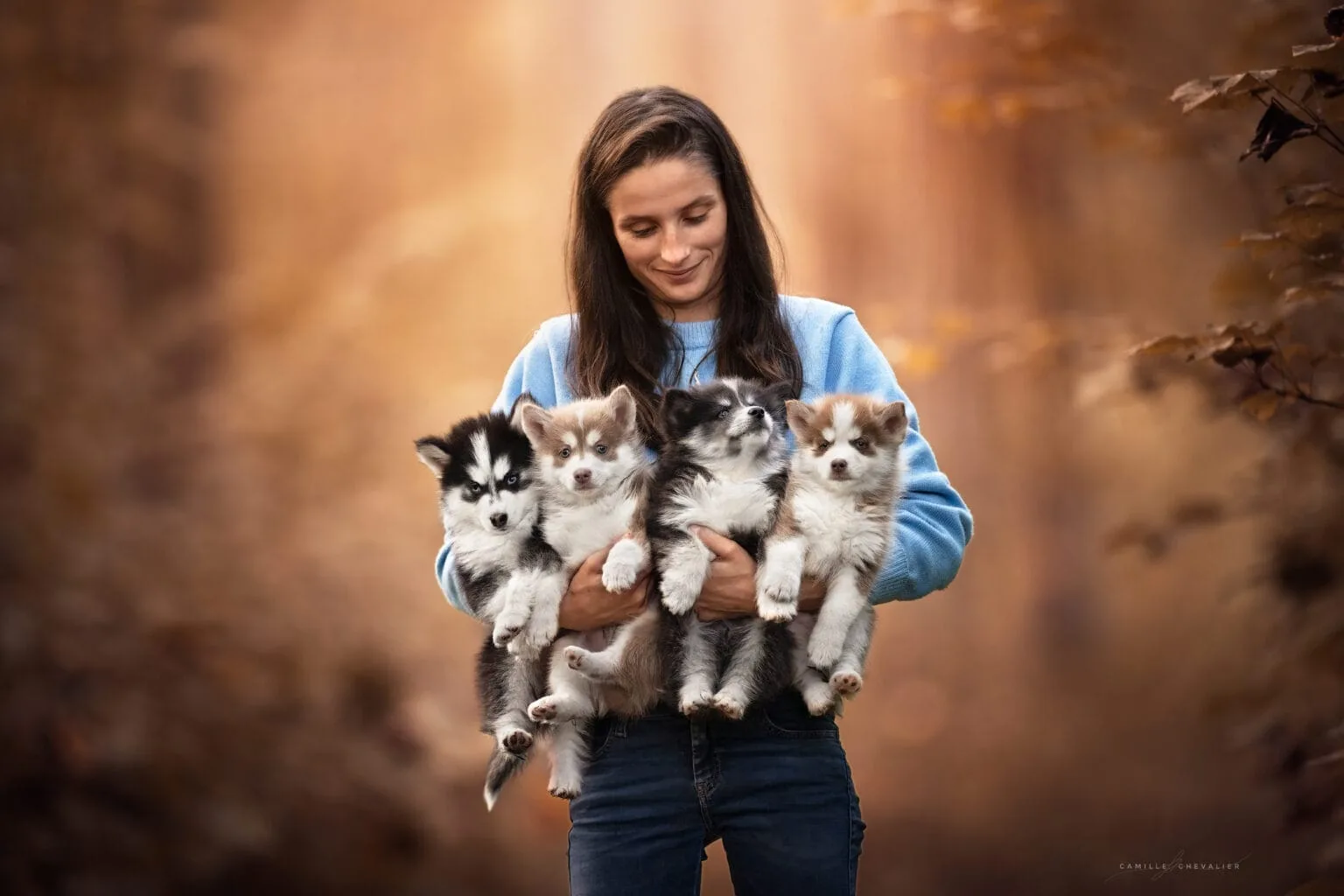
When you take an interest in the Pomsky, you quickly come across mentions of generations: F1, F2, F3… These notations describe the puppy’s genetic makeup and help anticipate some of its characteristics.
F1: the direct cross
An F1 Pomsky comes directly from crossing a Siberian Husky with a Pomeranian, one parent of each breed. This is the generation closest to the husky in appearance: larger build, slender silhouette, but also the most variability possible within the litter (size, color, coat length).
F2: back to a Pomsky line
An F2 Pomsky is born from crossing two F1 Pomskies, or an F1 with a Pomeranian. This generation starts to stabilize certain traits, generally with a somewhat more compact build than the F1.
F3 and later generations
F3 and later generations result from crosses between advanced-generation Pomskies. They tend toward a smaller build and a more uniform coat, but remain hybrid dogs with a degree of genetic variability.
Why it matters to know your puppy’s generation
The generation influences:
- Estimated adult size: the further along the generation, the more the build tends to shrink, though without absolute certainty.
- Coat type: some F1s keep a coat closer to the husky’s, others evolve toward a denser, Pomeranian-like coat.
- Temperament: overall, all generations remain lively and affectionate, but the balance between energy (husky) and emotional closeness (Pomeranian) can vary slightly.
At Royaume des Galopins, we systematically tell you the generation of each Pomsky puppy and answer all your questions to help you choose with full knowledge. Discover our available Pomsky puppies.