
The kennel journal
How Big Will My Pomsky Be?
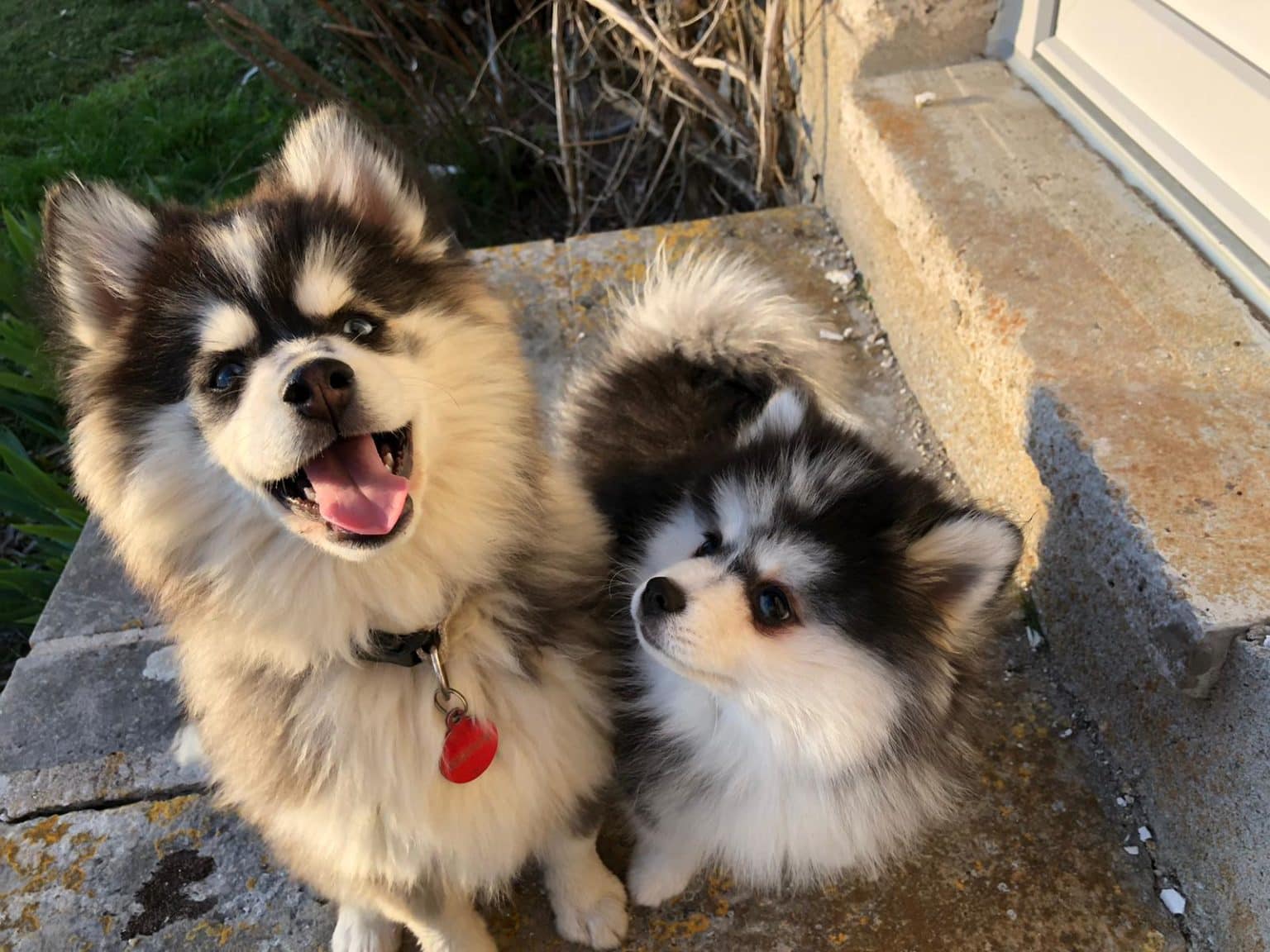
I have often seen this question on social media: how big will my Pomsky be? Size clearly is a real concern for a lot of families.
So F3s are supposedly smaller than F2s, which are themselves supposedly smaller than F1s — and in all of that, what exactly is an F1B, an F1A, an F2A, an F2B? It is easy to get lost.
Let us take it from the top.
It all starts with an F1 POMSKY
The Pomsky comes from a cross between a Husky and a Pomeranian; this first cross is called F1: 50% Husky, 50% Pomeranian. The mother is always the Husky, to avoid any problem during whelping.
Female Huskies measure 51 to 56 cm for a weight of 16 to 23 kg, while male Pomeranians measure between 18 and 24 cm for a weight of under 3.5 kg.
F1 Pomskies will often be around 40 cm and weigh roughly 11 kg — and again, this is not an exact science.
There is then a variation on this first generation, called F1B and F1A. Let us start with the F1B: it comes from a Pomsky * Husky cross. It will therefore be 25% Pomeranian and 75% Husky. The dog will be more Husky in type and will tend to be medium-sized. It still depends on the breeder’s selection, though — on whether the Husky and Pomsky chosen sit at the larger or smaller end of the average. The F1A Pomsky, meanwhile, comes from a Pomsky * Pomeranian cross: it will be 25% Husky and 75% Pomeranian. That pairing normally produces Pomskies smaller than the F1 and the F1B, but the puppies will be less Husky in type.
When we talk about “Husky type”, we mean in particular that lovely blaze marking. Note that this one is still called F1B by some breed clubs.
F2 POMSKY:
The F2 Pomsky comes from two F1 Pomskies, so 50% Husky and 50% Pomeranian. This is normally where we arrive at “mini Huskies” with attractive markings.
F3 POMSKY:
The F3 Pomsky comes from pairing two F2 Pomskies. Visually similar to the F2, although a further reduction in size may be sought. There are also F2A and F2B Pomskies, but I would invite you to read another article on the subject: Pomsky generations F1, F2, F2B — can someone explain?
What happens in practice?
The generation does not determine the puppy’s size. Neither does the size of the parents alone, because earlier generations can also affect it.
Even though the breed standard would have it that the smallest are the F1a, F2a and F3, it remains essential to question the breeder, who is meant to know their lines. Every breeder should be doing careful work on their lines, with a target size, particular markings and a playful, stable temperament in mind, so that the dog becomes a true companion for life.