The kennel journal
Is the Pomsky an Affectionate Dog Suited to Family Life?
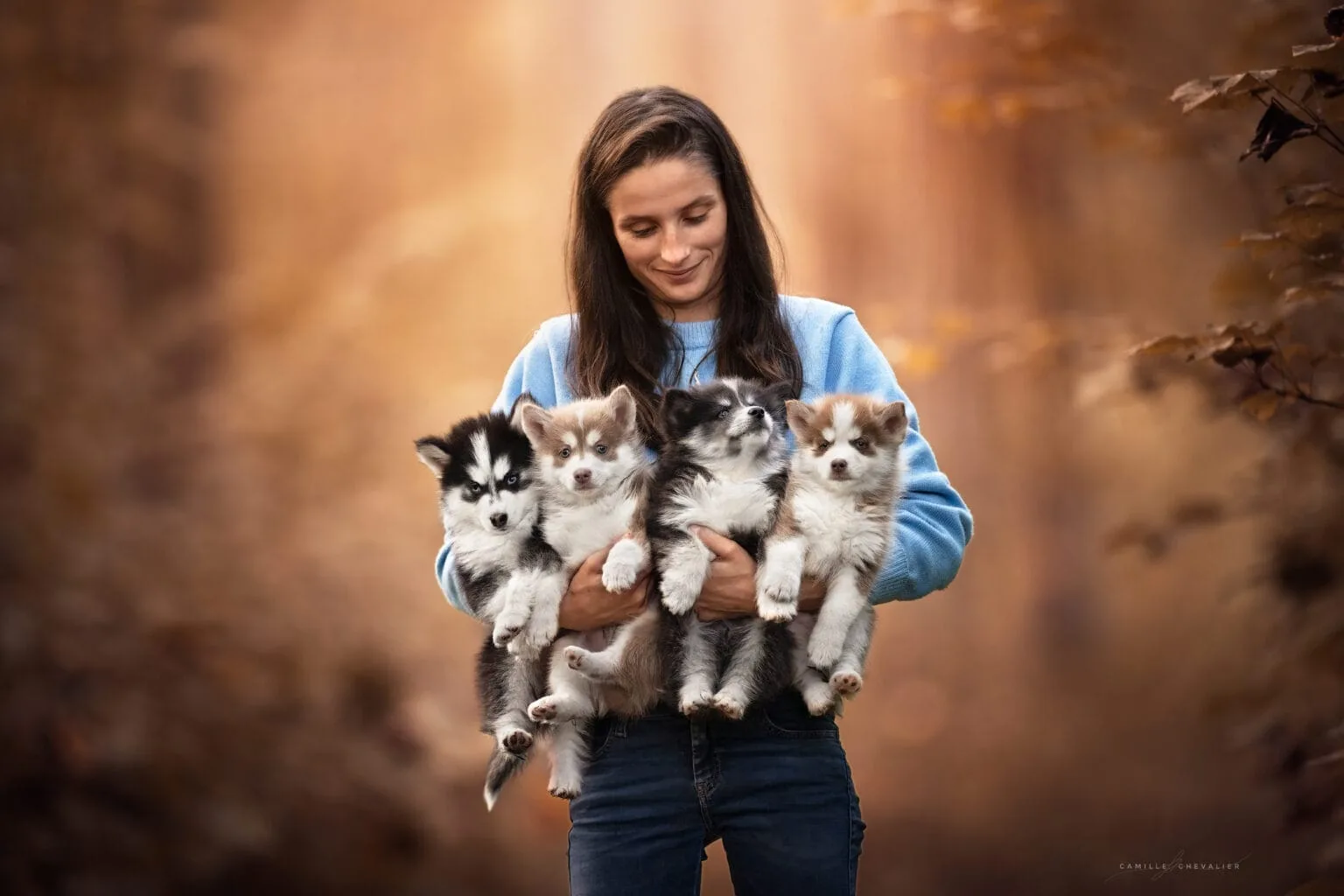
The Pomsky is a cross between a Husky and a Pomeranian. The aim of the cross is to soften the Husky’s character and reduce its size, in order to make the Pomsky an affectionate, devoted dog, perfectly suited to family life.
It is hard to find your way through all the articles written about the Pomsky. So is the Pomsky the perfect family dog, able to live in an apartment and with young children? The answer is yes.
Is the Pomsky affectionate or not? It all comes down to selection.
Today, selection and the way a puppy is raised vary so much from one breeder to another that it is hard to be categorical and to list the Pomsky’s character traits.
As in every breed, a dog’s character will in most cases depend on the following:
- The parents’ character
- The socialisation done by the breeder between 0 and 2 months
- The socialisation done by the adopter between 2 and 3 months
- The experiences and living environment the dog benefits from
So the selection the breeder makes among their breeding stock, and the time spent socialising the puppy, are what create an affectionate Pomsky — or not. The dog will then be more or less suited to family life, and will or will not have behavioural problems.
The Pomsky, a thoroughly gentle dog
In our kennel we have selected our breeding dogs for their big-teddy-bear character and their irresistible build.
Our dogs are sociable and are delighted to meet young and old alike. They are devoted companions; they love being close to us and following us everywhere in the garden. We have no difficulty at all walking them off lead — their recall is perfect. So it is a great pleasure to walk with them through the fields.
Our Pomskies adore children of every age, from a few-month-old baby to a teenager. We are lucky enough to have family and friends visiting the house regularly, so the puppies are handled and used to children.
To learn more about the Pomsky’s character: The Pomsky’s character
A character strongly influenced by the breeder’s choices
We have decided never to breed F1, B or A. To our mind, the first generation is not very stable. It remains the very first cross between a Husky and a Pomeranian, and it is hard to predict either the appearance or the character of the future puppies.
The B involves adding more Husky to the puppy’s DNA. You then end up with a puppy carrying 75% Husky blood and many of the Husky’s behavioural characteristics, such as escaping, recall problems, an independent streak and prey drive.
The A involves adding more Pomeranian to the puppy’s DNA. We are not in favour of that process either, because the puppies are then very Pomeranian in type and far less Husky, often with brown eyes. The dog may then show some of the Pomeranian’s characteristics, such as barking frequently.
We have therefore chosen to work with advanced generations — F3, F4, F5 — which lets us work with stable lines and produce puppies that are consistent both physically and in temperament.
In conclusion
In conclusion, this is a cross that is still not very stable. So it is important to choose your kennel carefully. The breeder strongly influences and determines your future puppy’s character, through the selection of the lines they work with, through socialisation, and through the generations they breed. So if you want a big teddy bear, you had better do your research, because the Pomsky can turn out angel — or demon.