
The kennel journal
Is the Adult Pomsky the Right Dog for You?
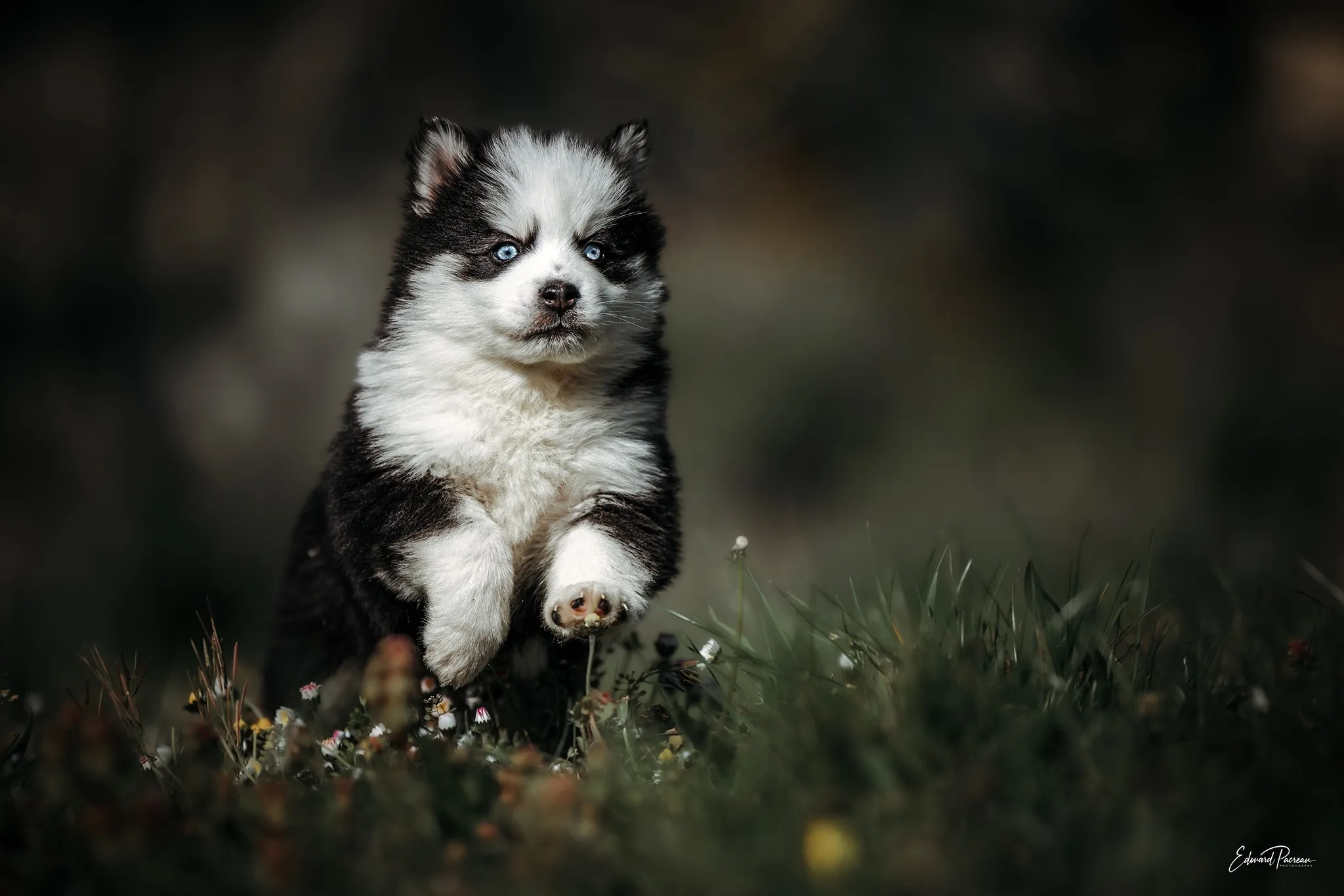
Are you fascinated by the adult Pomsky and wondering whether it is a dog that could suit your lifestyle? We are going to explain everything about the Pomsky and describe the character and appearance of our adult Pomskies.
First of all, you should know that there is great variety among Pomskies. The Pomsky is a very new cross between a Husky and a Pomeranian. So it is not yet a recognised breed, nor is it entered in the LOF, the French stud book.
The variety among Pomskies is found in size as much as in build. So it is difficult to describe an adult Pomsky, because they do not all resemble one another, the cross not yet being stable.
We will nevertheless describe them based on our own experience.
The Pomsky’s character as an adult
The aim of this cross was in particular to reduce the Husky’s size and soften its character, and it is a success. Our advanced-generation Pomskies — F3, F4, F5 — have an exceptional character. They are endearing, devoted, kind, affectionate dogs that we can walk off lead.
That thoroughly gentle character in our adult Pomskies comes from the selection of our lines but also from the socialisation we give our puppies.
Our Pomskies are raised in our house, around our family, our friends and children. We place great importance on their health, but also on their temperament; that is why we choose to raise the puppies within our home and not in kennels.
Our Pomsky puppies for sale are extremely sociable and playful, and each has their own personality: unique, very loving, intelligent and loyal. The Pomsky also gets on very well with children and will build a lovely bond with them. It is a gentle dog that approaches children with tact and delicacy.
The adult Pomsky is a devoted dog that does not like being alone. It loves being close to its human and spending time by their side. It is also a very intelligent dog that learns quickly. That intelligence can sometimes turn against its owners when its needs are not met. If you run into difficulty with your Pomsky, it is advisable to consult a behaviourist.
Our Pomskies are sociable with other animals. They get on very well together and also with the other breeds present at the kennel. We also have cats and there is no problem or friction between them.
Again, Pomskies are far from all having the same character. We have seen on social media that some suffer from escaping, house-training problems and destruction. So it is important to choose your Pomsky on physical characteristics but also behavioural ones, and to research the kennel you select.
Here is a link to learn more about their character: Pomsky kennel in the Paris region
Is the Pomsky easy to train?
Yes, Pomskies are easy to train, particularly through rewards. The Pomsky loves learning new commands; it is a very intelligent dog. They can learn commands from the age of 6–7 weeks: sit, down and, above all, recall, which should be taught from the earliest age.
Pomskies are eager to learn and to impress their owners, so you will be able to have fun and build your bond with your Pomsky.
Recall remains, to my mind, the first command to teach your Pomsky, so that you can walk in complete freedom and safety. An adult dog without recall is a dog that may get lost and put itself in danger, or a dog you will always have to walk on a lead or off lead only in an enclosed space.
House-training, as with all dogs, can go more or less quickly. It all depends on whether the breeder has already started teaching it or whether everything remains to be done. In any case you need to show patience and kindness. A puppy does not necessarily understand what you expect of them and, above all, does not have the ability to hold on before the age of six or seven months.
In any case we do not recommend the use of a crate, which can speed up house-training but at the puppy’s expense, since they find themselves constrained and forced.
How much exercise does an adult Pomsky need?
The Pomsky is not a difficult dog to train, nor one that presents behavioural problems, unless it falls victim to boredom. As with any dog, it is important to meet its needs and offer it varied activities. When we talk about activities, we mean physical as much as mental ones.
Below we reproduce the pyramid of canine needs, which applies perfectly to our adult Pomskies’ needs.
To my mind, social needs are very developed in the Pomsky; it is a devoted dog that can struggle with solitude. I have seen many videos of Pomskies howling like wolves repeatedly when left alone. It is true that the Pomsky descends from the Husky, a pack dog that loves living in a community and enjoying physical activity.
The Pomsky is a lively dog that will need to burn off energy. You can set up plenty of activities with it: swimming, agility, obedience, cycling, running. Despite what you might think, the Pomsky is a dog that loves to swim. It is not unusual for us to find our Pomskies in the pool or in their water tub. They are also delighted to throw themselves into a lake or a river.
The Pomsky is a northern dog and will therefore also enjoy winter sports, so it can happily follow you on a hike or a ski descent.
Even so, it is important to adapt activities to your Pomsky’s age and build. A 4 kg Pomsky will not have the same needs or capacities as a 12 kg Pomsky.
Remember that a well-stimulated dog whose needs are respected is a happy dog, comfortable in its own paws.
Can the adult Pomsky be walked off lead?
The question of off-lead walks does come up regularly. It is far more pleasant to be able to walk or cycle with your dog free but attentive.
One of the great difficulties with the Husky is achieving recall, that is, a dog that comes back when you call.
To achieve recall it is important to work on it from your Pomsky’s first months. It is also important to establish a relationship of trust from the earliest age. Your Pomsky must know that when it comes back, something positive awaits: a treat, a stroke, a reward. If coming back brings them something positive, then you can be sure they will be more inclined to do it.
In our kennel our Pomskies have good recall. So we can enjoy lovely off-lead walks through the fields. It must be said that our Pomskies take more after the Pomeranian’s character, a devoted dog that follows its owner everywhere.
In any case, if you have any doubt about your dog’s recall, it is important always to walk them on a long line and in places without risk. Recall keeps your dog safe and prevents a great many accidents. You should never let a dog off lead until you are sure they will come back if you call. Many dog trainers can help you work on recall.
How does the adult Pomsky get on with dogs, cats and children?
The Pomsky is a sociable dog that loves the company of people and of other dogs. It is a gentle dog that adapts very quickly to a new environment.
All our Pomskies are loose within the kennel and they adapt perfectly to the arrival of a new dog or a guest.
The Pomsky has a gentle approach, which lets it get on well with children. Its small size is not intimidating for a child, and its very affectionate side often appeals to them. These are also dogs that bark little, which further builds the confidence of the youngest. Of course it remains important to supervise the relationship between a dog and a child, so as to step in quickly if either feels uneasy.
Our Pomskies get on perfectly with plenty of dogs, small and large alike. Our Pomskies are open and have no difficulty when they meet a dog outdoors. It is important to let your Pomsky meet dogs of every size and breed from the earliest age.
As for other species — rabbits, cats, chickens — we have no particular difficulty either, as long as they are around that other species from a young age. It nevertheless remains important to supervise and monitor the relationship with an animal smaller and more fragile than your Pomsky.
Remember that the key to a sociable, thriving dog is to have stimulated them between three weeks and three months. Every experience must always be positive and kind. Nothing is ever lost, but early work greatly eases your Pomsky’s learning and development.
What is a Pomsky’s lifespan?
The Pomsky is a primitive dog resulting from two fairly robust primitive breeds, the Pomeranian and the Husky. Both of these breeds have a lifespan of around 15 years. Since the Pomsky is a recent cross, it is difficult to have precise data on the Pomsky’s lifespan and diseases.
That said, being a recent cross, the Pomsky has not yet fallen victim to over-selection and to the appearance of defects linked to human selection. It remains important to ask your breeder for the health tests, and in particular the Embark test, in order to be sure of having a healthy dog.
The Pomsky therefore has an average lifespan of between 13 and 15 years, which is standard for a dog of its size.
Scams involving the Pomsky
It is true that we have seen many accounts of scams. Since the Pomsky is a non-LOF dog, every breeder sets their own standard and can call their puppies Pomskies. So it is important to come and visit the kennel in question and ask questions about the parents. You need to be careful and to do your research before buying a Pomsky.
A Pomsky should have only two breeds present in its DNA: the Husky and the Pomeranian. More and more breeders in the United States allow the presence of a third breed, which helps stabilise the Pomsky standard. In France the presence of another breed is tolerated as long as it is not present at more than 15%.
To find out which breeds are present in your Pomsky’s DNA, you can carry out an Embark test, which can be bought directly online.
In any case it is important to do your research before buying, because once committed you will not be able to take action against a breeder who has sold you a dog resulting from a cross of five breeds. The Pomsky is not a breed and is non-LOF; recourse is therefore very complicated.
The adult Pomsky’s eye colour
The Pomeranian’s eye colour is often brown, except for merle or phantom merle Pomeranians, which can have blue eyes. The Husky has far more varied eye colours, ranging from blue, brown and green to odd eyes and parti-coloured eyes (a mix of blue and brown within a single eye).
The Pomsky offers wide variation in coat but also in eye colour. Pomskies can have blue eyes, parti-coloured eyes (blue and brown within the same eye), odd eyes (one blue eye and one brown), amber, brown or green eyes.
Eye colour remains one of the main concerns and one of the main criteria for many future Pomsky adopters. The most desired colour remains blue.
What size is the adult Pomsky?
Since the Pomsky results from a cross between a Husky and a Pomeranian, we see very considerable variation in size.
A Pomsky’s size ranges from 4 kg to 16 kg depending on the lines and also on the generation. Every breeder is free to make whatever selection they wish. So depending on the parents’ size and the line being worked, the puppies will be larger or smaller.
In our view a Pomsky should be of medium size, that is, smaller than a Husky and larger than a Pomeranian. That medium build allows plenty of sporting activities with your dog while also making life in a city and in an apartment possible.
It is difficult to predict a Pomsky’s size at birth unless you know the lines well. In any case your breeder will be able to inform and guide you according to your wishes.
Coat length in the adult Pomsky
Pomskies have a double coat, with an undercoat and a topcoat. As for coat length, we distinguish:
Short coat, called standard
Medium coat, called Fluffy
Long coat, called Wooly
Not every adopter necessarily wants the same coat length. Some will want a very short coat so that their Pomsky resembles a mini Husky, while others will prefer a medium or long coat in order to have the thoroughly soft look of a big teddy bear. Here too it depends on each family’s taste, and it is possible to find long and short coats in every generation.
Do have a look at our other blog post on Pomsky generations: Pomsky generations F1, F2, F2B — can someone explain?
Does the Pomsky shed?
The Pomsky is not a dog that sheds a great deal. It is, however, a dog that moults. A seasonal moult is a heavier than usual loss of coat that lets a dog renew its coat. That moult is impressive in the Pomsky: the dog loses hair in handfuls and, within a few weeks, entirely renews its coat.
The moult generally happens twice a year in the Pomsky, at the change of seasons. This cannot be avoided, since it is an entirely natural, healthy process. You can, however, brush them every day during that period in order to limit the inconvenience for you and for them.
The adult Pomsky’s colours and masks
You will have seen in our previous paragraphs that the Pomsky offers great variation in terms of size, character, eye colour and coat length — and that is not all. The same is true of build and coat colour.
Pomsky coat colours are very varied: black and white, chocolate and white, grey and white, red, wolf grey, pinto, and many exotic colours: blue, silver, lavender, merle. Every breeder is free to work with whatever palette appeals to them. Fewer and fewer clubs accept the merle colour within the breed standard.
In our kennel we have chosen to offer genuine mini Huskies. We mainly aim for a fluffy, that is medium, or woolly coat, to reduce the Husky’s size and to soften its character. We have a roadmap and a standard we seek to respect. Our puppies mainly have a blaze and colours found in the Husky: black and white, grey and white, cream and white, sable and white, chocolate and white, agouti, pure white, red, and finally blue as an exotic colour.
Do get in touch if you have any questions.
Le Royaume Des Galopins