
The kennel journal
Activities for Your Pomsky: Ideas for Making the Most of Your Pomsky
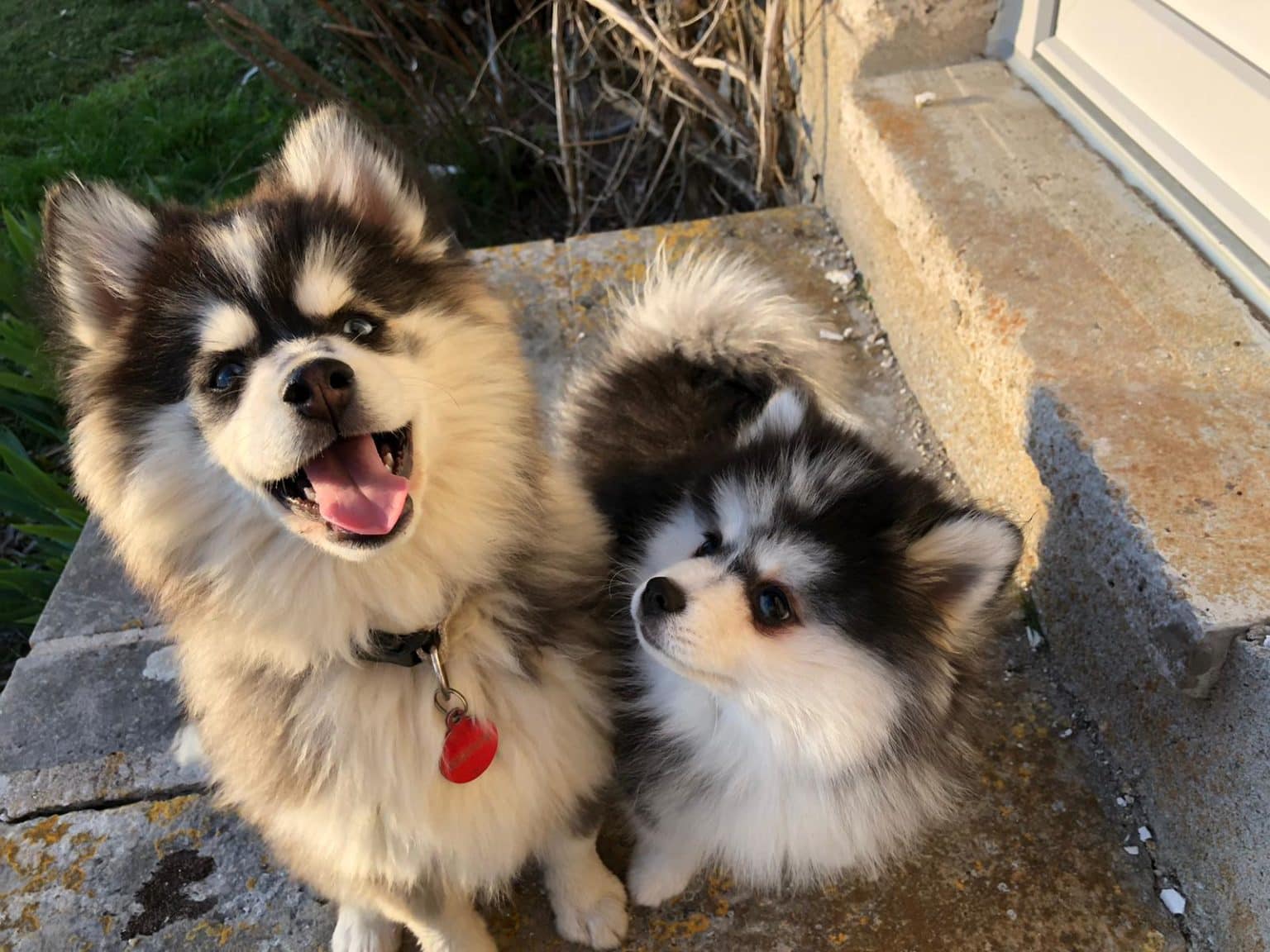
Introduction: what is a Pomsky?
The Pomsky is a dog resulting from a first-generation cross between a Husky and a Pomeranian. It is a small to medium-sized dog perfectly suited to family and city life.
The Pomsky appeared in the 2000s in the United States. The aim of the cross was to create a small dog resembling the Husky but with a gentler character suited to family life. The Pomsky therefore has the Husky’s features, often with the handsome blaze mask and a coat close to the Husky’s. It brings to mind an eternal Husky puppy with a more adaptable character.
Crossing two very different but complementary breeds aims to create a new type better suited to city life. Today the Pomsky can live perfectly well in an apartment and alongside other small animals.
Despite its small size, we should not forget that the Pomsky is a dog with a percentage of Husky DNA. It therefore needs to burn off energy physically and mentally. In terms of character, the Pomsky will have the Pomeranian’s playful, outgoing, sociable side, but also the Husky’s determined, stubborn, adventurous and affectionate side. So it will be important to stimulate it properly and also to set precise rules from the earliest age, in order to give it the framework it needs and finds reassuring.
In terms of health, the Pomsky lives on average between 10 and 15 years. It is a hardy dog, it has stamina, and it copes very well with hot and cold temperatures alike. If the parents are tested and the breeder has made a good selection, it is a healthy dog; there are no known pathologies to be vigilant about for the moment. It is nevertheless advisable, as with any puppy, to have annual veterinary check-ups to confirm your puppy’s good health.
There are many Pomskies and they are far from all resembling one another. Depending on their size, line and generation, your Pomsky will not necessarily need the same level of activity. If you want to know more about the types of Pomsky, do read the following blog post: Pomsky generations F1, F2, F2B — can someone explain?
Walks and hikes with your Pomsky puppy
The Pomsky is a lively little dog full of energy. So it is worth offering it, according to its age, various activities to do with you. Below you will find a table summarising the various activities you can do with your puppy according to their age, which will let you adapt the activities for your Pomsky.
One of the activities your Pomsky will adore is walks and hikes. There is a wide variety of walks and you can vary them regularly, which will stimulate your puppy further. Varying the walks and activities for your Pomsky is essential.
The first walk that comes to mind is the toilet walk, a more or less short outing lasting from a few minutes to around thirty, taken around the family home. The dog is often kept on a lead and the primary aim of this walk is to let the dog relieve themselves. This walk therefore has the advantage of letting your Pomsky puppy relieve themselves, but it will offer little stimulation in terms of physical exercise, mental exercise, exploration or social encounters, since the dog stays in a familiar environment. The toilet walk nevertheless remains an essential, necessary part of your dog’s life.
The second walk you might consider is the training walk. During this outing the dog will, as usual, walk, run and play, but the walk will be punctuated with learning. This walk is therefore an opportunity to work on recall, for instance, or on the “stay” command. This walk can be more or less short. It is worth preparing it in advance in order to stimulate your dog properly. As you will have gathered, this walk will above all let your dog burn off mental energy and, to a lesser extent, relieve themselves or burn off physical energy.
The classic walk can take place around the family home or somewhere else. It will vary in length and will aim to meet as many of the dog’s needs as possible. It is a walk best done on a long line; in any case, avoid a lead that is too short. The dog can then meet their needs for physical and mental exercise, and it also lets them relieve themselves. Unlike the toilet walk, it is meant to be more stimulating, leaving the dog more freedom to discover. Do vary the locations of this walk, which will delight your companion and in particular their need to explore.
The group walk aims to bring together various owners and their dogs. It is a very worthwhile walk because it stimulates almost all of your dog’s needs. It meets the need for social encounters. It lets you walk in places you do not usually go — these walks often take place in woodland or across fields — which meets your dog’s need to explore. Your dog will be surrounded by other dogs, so they will burn off more energy and fully meet their need for physical exercise. Dogs also learn a great deal by imitation, so it will be an opportunity to meet their need for mental exercise.
Activities for your Pomsky: interactive games
It is very worthwhile offering your Pomsky interactive games. These stimulate their senses and help develop their cognitive ability. We keep coming back to the idea that it is important to vary the activities for your Pomsky. Interactive games are strongly recommended by dog trainers but also by breeders. They stimulate your dog’s intellect, make them think, and also keep them occupied while you are out. They are also a good means of strengthening your bond with your four-legged companion and building their self-confidence.
There is now a very wide variety of interactive games, all with the same aim: making your dog think so that they find the solution. Among interactive games we might mention noisy balls, which make a sound every time your dog pushes them or takes them in their mouth. That sound encourages your dog to play for longer and is more stimulating than a simple tennis ball. Noisy balls also often come in shapes and colours that stimulate your dog’s other senses.
Hide-a-squirrel is a game shaped like a tree trunk with holes in which squirrels hide. Your dog tries to get the squirrels out of their hiding places. This game is worthwhile because it works your dog’s various senses. It follows much the same principle as the snuffle mat, in which you scatter kibble.
Kibble or treat dispensers come in every brand and every shape: balls, rings, bones. Your dog will use their nose and make various movements in order to get the kibble out.
Puzzles also come in great variety, but the principle is the same every time: your dog has to move various pieces with their nose or their paws in order to find treats hidden underneath.
Agility and dog sports are suitable activities for your Pomsky
Agility is one of the best-known dog sports. It is a discipline practised by a dog and its owner, the aim being to complete a course that often includes obstacles, dog walks, tunnels, hurdles, seesaws and ramps. The aim of agility is to complete the course as fast as possible with as few faults as possible. Of course this sport is intense and you will need to wait until your dog is at least 12 months old before doing agility. You can, however, start earlier if the obstacles are left on the ground and no jumping is involved. Likewise, you should not ask too much in terms of speed. The primary aim of these precautions is to protect their joints.
Agility is a very rewarding sport: it lets you develop a strong bond with your dog, teach them new commands, work on their concentration, and meet their needs for physical and mental exercise.
There are now many agility clubs where you can practise this discipline. Otherwise you will also find courses for around a hundred euros on Amazon or equivalent sites.
Among the sports you can do with your Pomsky there is also dog dancing, a canine training discipline practised to music. It is a very interesting discipline that gives the impression that owner and dog are dancing together. Through outstanding rapport and perfectly executed commands, the owner and their dog perform various figures and routines. This discipline strengthens the bond between dog and owner while also providing physical and mental exercise. There is also the Instagram account Sya_pomsky, which you can have a look at. Sya and her owner have been doing dog dancing for a few months and the result is simply incredible.
Among suitable activities for your Pomsky we can also mention canicross, another very worthwhile dog sport you can do with your Pomsky. Canicross involves running with your dog while attached to them. This discipline was created to train Huskies during periods of high heat. It has now become widespread and can be practised with any type of dog. Still, it is worth remembering that the Pomsky has a percentage of Husky DNA and should therefore be very keen on this activity. Canicross remains an intense sport, so it is important to wait until your Pomsky has finished growing before doing it with them. A veterinary check-up will also be important to confirm that their physical condition allows this discipline. Finally, you will need to equip your dog with suitable kit, in particular a harness specially designed for canicross.
Socialising the Pomsky: the key stages
Among the activities to practise with your Pomsky we can also mention puppy socialisation, a key stage for the Pomsky but also for any dog.
The first socialisation work begins at the breeder’s. By the time they leave, between two and three months, the puppy should already know various noises, should not be fearful, and should show an outgoing, playful character. It is essential that the breeder has done this socialisation work in order to ease their arrival in your home and their future learning.
Socialisation is an everyday matter and must not be neglected if behavioural problems are to be avoided. Every noise at home is an opportunity to socialise the puppy. The same goes for outings, where the various encounters, noises and smells will naturally awaken your puppy.
In order to have a well-trained Pomsky it is essential to proceed little by little, discovery by discovery. You need to make sure every new experience is positive for the puppy. Any encounter or situation in which the puppy feels in danger and shows signs of stress should be stopped immediately.
The Husky remains a fairly wary dog, particularly with strangers, and although the Pomsky is outgoing in most cases, it remains important to be vigilant and to work properly on this point from the earliest age. Remember that every outing, and even every indoor activity, is an opportunity to socialise your puppy. The worst mistake is never taking a puppy outside and settling for walks in the garden. A poorly socialised puppy is a future fearful dog that will develop behavioural problems.
Indoor activities for your Pomsky
It can also be worth considering indoor activities for your Pomsky. We do spend many hours at home, so it is worth being able to stimulate your Pomsky indoors too.
Among the worthwhile activities we have already mentioned are interactive and occupation games. They let your dog keep busy and make the time feel shorter. Another indoor essential is chewing activities, with hooves, pig’s ears, deer antler and so on. Chewing is very important for any dog: it prevents boredom and protects their teeth.
You can also do obedience games with your dog. In slots of 5 to 10 minutes you can teach your dog a new command. This activity lets your dog burn off mental energy. To my mind the most important command to teach your Pomsky, and any dog more broadly, is recall, that is, coming back when you say their name.
You can also play hide and seek with your dog. This game develops their sense of smell and their hearing. The game involves asking your dog to sit in a room and not move, then going to hide in another room. You then call your dog and they have to find you as quickly as possible. A pleasant, simple activity to do.
Conclusion
So you will have gathered from this article that despite its small size, the Pomsky, resulting from the cross between a Pomeranian and a Husky, needs physical but also mental exercise. It is a lively little dog whose needs must be met throughout its life. In this article we have mentioned many activities you can do with them: walks, hikes, games, sport, socialisation, obedience. In any case it is important to vary the activities but also to adapt to your dog’s age and needs. Every Pomsky is unique and will not have the same needs.
In any case, before being an adorable mini Husky, the Pomsky remains an active, lively dog that will need a minimum of an hour and a half of activity a day. We will leave you to create your schedule and enjoy yourselves with your little one.